

A product manager at a Lagos fintech inherited a codebase in 2024. One architectural assumption ran through every screen. The connection will be slow. Sometimes it will not be there.
The assumption had been correct when the codebase was written in 2019. By 2024, it was no longer accurate for most of the product's active users.
Three subsea cables arrived in African waters within eighteen months of each other.
Equiano, backed by Google, went live in 2023 across South Africa, Namibia, Nigeria, and Togo. Its design capacity is 144 terabits per second. PEACE landed in Kenya in December 2022 with a capacity of 96 terabits per second. 2Africa - backed by Meta - connects 33 countries across three continents. It began staging activations across East and West Africa through 2023 and 2024. Its design capacity is 180 terabits per second. Together the three cables deliver more bandwidth to the continent than all previous cables combined.
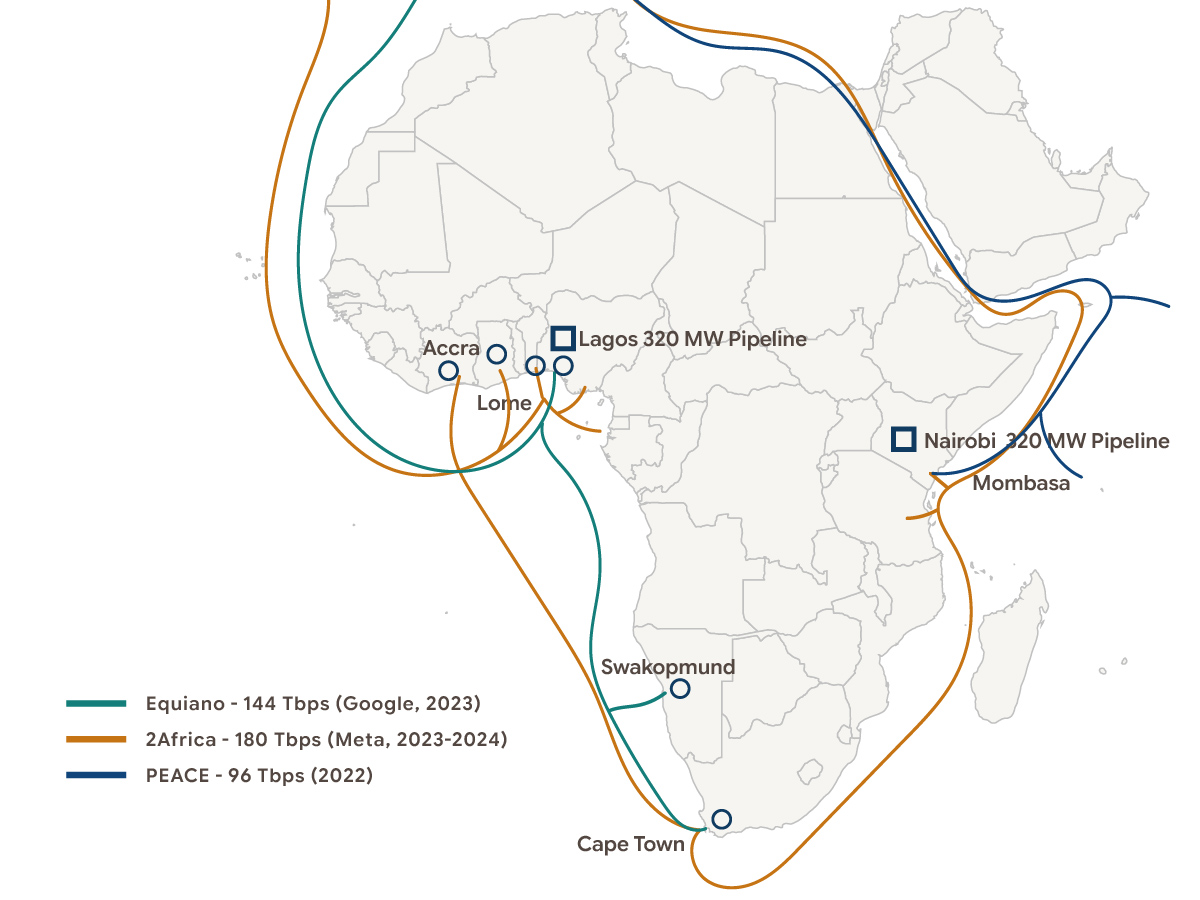
The latency effect is measurable. New cable routes have reduced round-trip times to Europe and the Middle East by 20 to 40 milliseconds.
Data centre capacity is accelerating in parallel. Nigeria had approximately 86 megawatts of operational capacity in 2025. Over 320 megawatts are under construction or in the pipeline. Lagos will receive a $250 million hyperscale facility when the Nxtra project comes online in 2026. iXAfrica secured a 20-megawatt expansion in Nairobi in January 2025. Microsoft is investing $1 billion in Kenya. Starlink reached 25 African countries by December 2025.
The products that defined African mobile software in the 2010s were built for a specific constraint. Bandwidth was scarce, expensive, and intermittent. Offline-first architecture was not a design choice. It was a user requirement.
The products built under that constraint made rational decisions. Lightweight payloads. Progressive loading. SMS fallback. Minimal images. Local data caching. Those decisions are baked into codebases and product thinking across the region. Many teams still hire and train for that design context.
The constraint that generated those decisions is being removed from below. A product built in 2019 for 3G conditions in Lagos now competes in a different market. A growing share of its active users is on faster infrastructure. The 2019 product will feel the gap before its team notices it.
The constraint shaped specific product decisions across categories. Enterprise tools stayed text-heavy to save data costs. Consumer apps stripped out media. Products defaulted to WhatsApp because a 2G fallback was required. Each of those decisions can now be revisited. The infrastructure ceiling moved. The product design floor has not.
The cloud-pricing gap explains why better connectivity has not yet made local computing cheap.
This is not a uniform shift. Connectivity improvements are concentrated in cities and along cable-landing corridors. Rural users face the same constraints they always have. The product design calculus is not binary. But the premium segment in Lagos, Nairobi, and Accra is operating on infrastructure that has changed. These are the users most B2B and consumer products are built around. A constrained product design no longer matches their actual connectivity.
The gap creates a product opportunity in two directions.
For new products, the design constraint is not what it was. Building offline-first for a Nairobi user in 2026 is a choice, not a requirement for most use cases. A product built on current infrastructure delivers a noticeably better experience than products designed for 2019 conditions. The quality gap against incumbents is real and widening.
For existing products, the risk runs in the opposite direction. A newer product built for 2026 infrastructure will feel noticeably better than an incumbent designed for 2019 constraints. The gap is quality, not features. The window to upgrade is narrower than the window to build from scratch.
AWS Africa cloud pricing has not yet caught up to the cost reductions that new infrastructure enables. Regional pricing remains higher than equivalent US and EU regions. That gap will close as competition increases and cable economics improve. Founders who build now, before it does, carry lower infrastructure costs for longer.
The infrastructure changed. Most product assumptions did not.


