

A Lagos fintech founder applied for a PSSP license 14 months into building his product.
The CBN review found he needed an IMTO license instead. The infrastructure he had built did not qualify. That is not a compliance failure. It is an architecture decision made with incomplete information.
African fintech licensing is not one process. It is a set of distinct processes with distinct capital requirements, timelines, and operational constraints.
In Nigeria, the Central Bank categorises payment operators across several distinct license types. Each governs a different class of activity. A PSSP processes domestic payments. An MMO holds float and disburses cash. An IMTO moves money across borders. Choosing the wrong one is not an error corrected in weeks.
A PSSP license requires NGN 100 million in capital deposited with the CBN. Per TechCabal analysis of CBN licensing requirements in May 2025, the process runs in two phases. Approval-in-Principle takes 3 to 6 months. Final license issuance takes a further 2 to 4 months. Total elapsed time: up to 10 months before a single transaction is legally processed. An IMTO license requires a minimum of $1 million in operating capital for foreign operators.
Kenya faces a different version of the same problem. The Central Bank of Kenya had over 200 pending fintech applications as of mid-2025. The Kenyan government responded by proposing a National Fintech Regulatory Commission Bill. The bill would create a dedicated licensing body separate from the CBK to reduce the backlog and standardise timelines.
The standard advice to African fintech founders is to handle regulation early. That framing understates the problem.
The regulatory pathway is not a compliance checklist appended to a product. It is the foundational decision that determines what the product can legally do. A founder building a remittance product who applies for a PSSP license has chosen the wrong pathway. A PSSP covers domestic payment processing. An IMTO covers cross-border money movement. They operate under different capital structures, different compliance frameworks, and different activity sets. A product built against the wrong license does not become compliant by switching license types. It requires architectural changes.
NALA announced its CBN IMTO license in March 2026. The license came with a direct integration into NIBSS, the national settlement system. NALA now holds 14 licenses across its operating markets. That number is not a compliance achievement. It is an operational map. NALA can process transactions in the markets where it holds a license. It cannot in the ones where it does not.
The regulatory information that NALA acted on is public. CBN circulars, CBK policy documents, FinTechNG guidance notes. It is not hidden. It is scattered, written for compliance officers, and not synthesised for founders building products. That gap is where most founders lose months.
The Nigeria licensing cost guide makes the capital implications concrete for founders choosing a pathway.
Both the CBN and the CBK operate regulatory sandbox programs. These change the entry calculus for founders who know they exist.
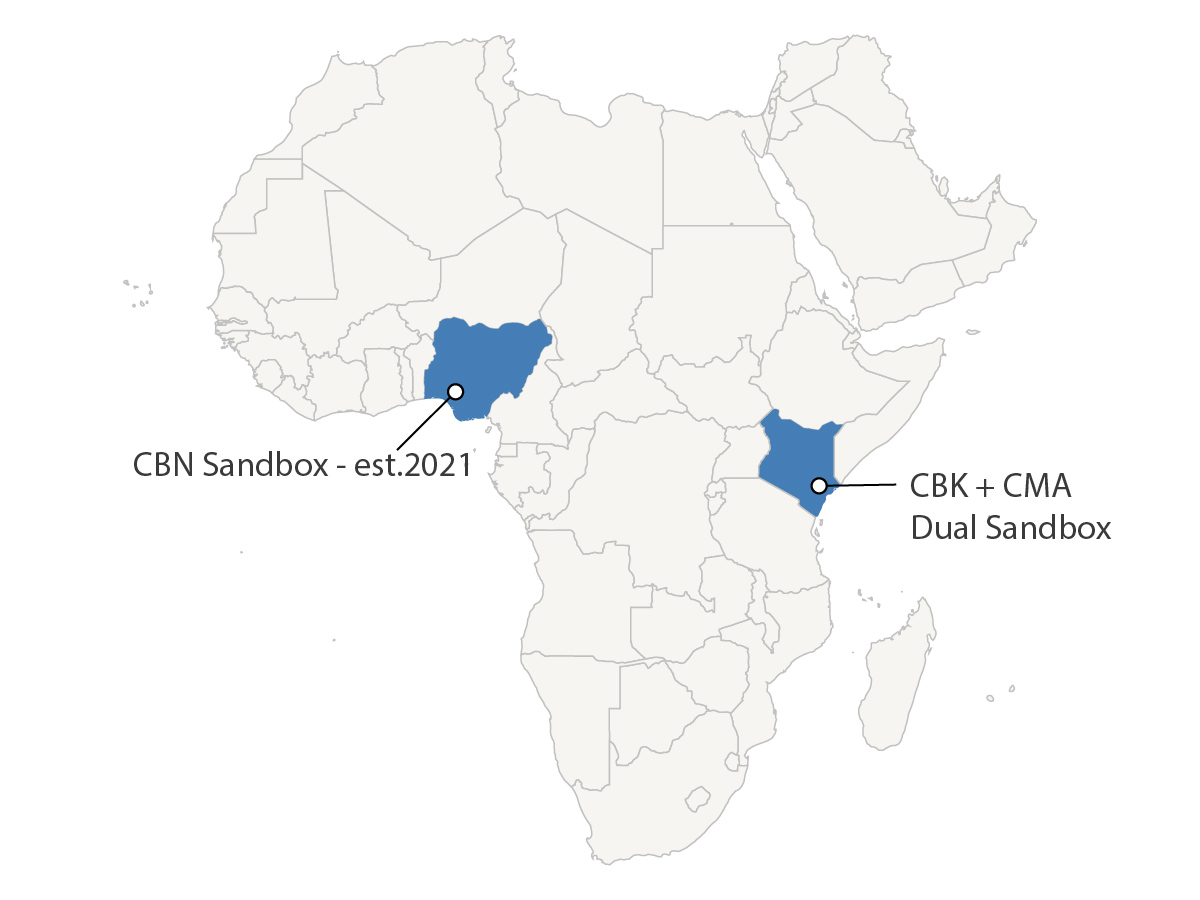
The CBN regulatory sandbox, established in 2021, allows operators to test products under CBN supervision before committing to a full license. Eligibility assessment takes 45 working days. The testing window runs for six months. The CBN 2026 fintech policy report calls for expanding the sandbox to cover AI, cross-border payments, and embedded finance. The expansion would extend the lighter-requirements window to more product categories.
Kenya operates a dual sandbox - the CBK and the Capital Markets Authority run parallel programs. Both allow fintech products to operate under relaxed conditions before the full license application begins.
The sandbox path produces revenue and product evidence under lighter requirements before the full licensing cost lands. Most founders discover the sandbox after filing for the full license.
The founders who navigate Africa fintech regulation well share one structural advantage. They chose the license before they chose the architecture. The license determines the capital requirement, the permitted activity set, and the viable exit paths. None of those are adjustable once the product is built.
Africa fintech regulation is not the obstacle it is described as. It is an architecture input that most founders pick up too late.
The regulatory-navigation opportunity is the product layer that could turn scattered rules into buildable decisions.


