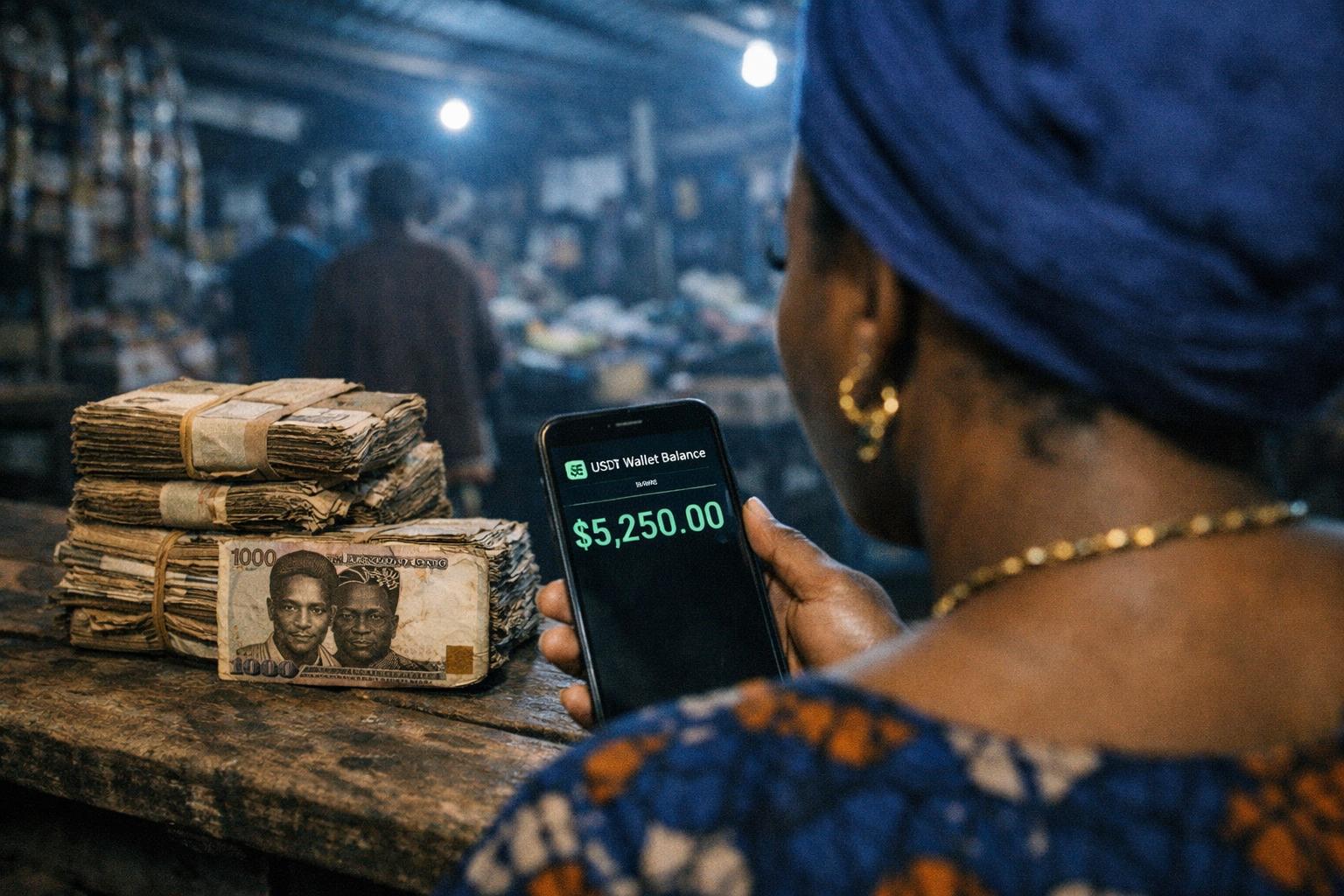

On a Friday afternoon, a Lagos importer opens a wallet before calling a bank.
Her supplier needs dollars, and the bank transfer remains uncertain.
That pause explains Nigeria's stablecoin payments story better than any currency launch.
The CBN's eNaira remains legal tender and the digital form of the naira.
Yet policy analysis now treats dollar stablecoins as a meaningful cross-border payments channel.
The IMF estimated that Nigeria received about $59 billion in crypto-asset inflows between July 2023 and June 2024.
Nigeria also accounts for roughly 60 percent of Sub-Saharan Africa's stablecoin inflows since 2019.
Those figures measure flows, not unique users, merchants, or settled trade invoices.
They still describe a payment behaviour that cannot be dismissed as speculative noise.
The CBN describes the eNaira as a wallet-based CBDC.
That makes it public money in digital form, not an alternative dollar account.
Stablecoins meet a different demand.
They offer a transferable dollar-linked balance where foreign exchange access, settlement speed, and remittance costs remain difficult.
The contrast is not a vote against public money.
A naira CBDC can support monetary sovereignty and domestic payment infrastructure.
The IMF's 2026 Article IV report makes that case directly.
It also says regulated, naira-denominated stablecoins could complement the domestic payment ecosystem.
That is a more useful frame than declaring one architecture victorious.
Nigeria's payment market is separating tasks that were once forced through one channel.
The state can issue money and oversee payment systems.
Private networks can move value across borders with different settlement economics.
The hard work begins where those systems meet.
Dollar stablecoins reduce transfer friction, but they also create digital dollarization and financial-integrity risks.
The same speed that helps an importer pay a supplier can weaken visibility over naira conversions.
The IMF calls for transaction monitoring, stronger supervision, and better data at that interface.
That turns the conversion layer into the real product surface.
The buyer of that product is not looking for a crypto feature.
She is looking for a payment that can be approved, tracked, reconciled, and defended during an audit.
That requirement makes local liquidity and credible off-ramps more important than a faster chain.
It also makes licensed partners more valuable than anonymous volume.
Builders should resist the temptation to launch another wallet and call it infrastructure.
Corporate customers need reliable conversion, documented counterparties, treasury controls, and proof that payments reached the right account.
Those needs are less visible than a token transfer.
They are also harder for an unregulated payment rail to solve.
A finance lead needs a clear exchange rate, a named counterparty, and a record that survives month-end close.
A supplier needs funds that can be converted and used without an informal sequence of favours.
Those are operational promises, not blockchain features.
The strongest products will make compliance part of the transaction path.
They will reconcile naira and stablecoin balances, screen counterparties, and expose settlement status to finance teams.
That work is adjacent to the opportunity in business stablecoin on-ramps.
It also extends the evidence in Africa's stablecoin adoption story.
The strategic question is not whether Nigeria chooses the eNaira or stablecoins.
It is who makes their regulated handoff dependable enough for real businesses.
Payment rails become durable when the last mile is trusted, not when the token is fashionable.