
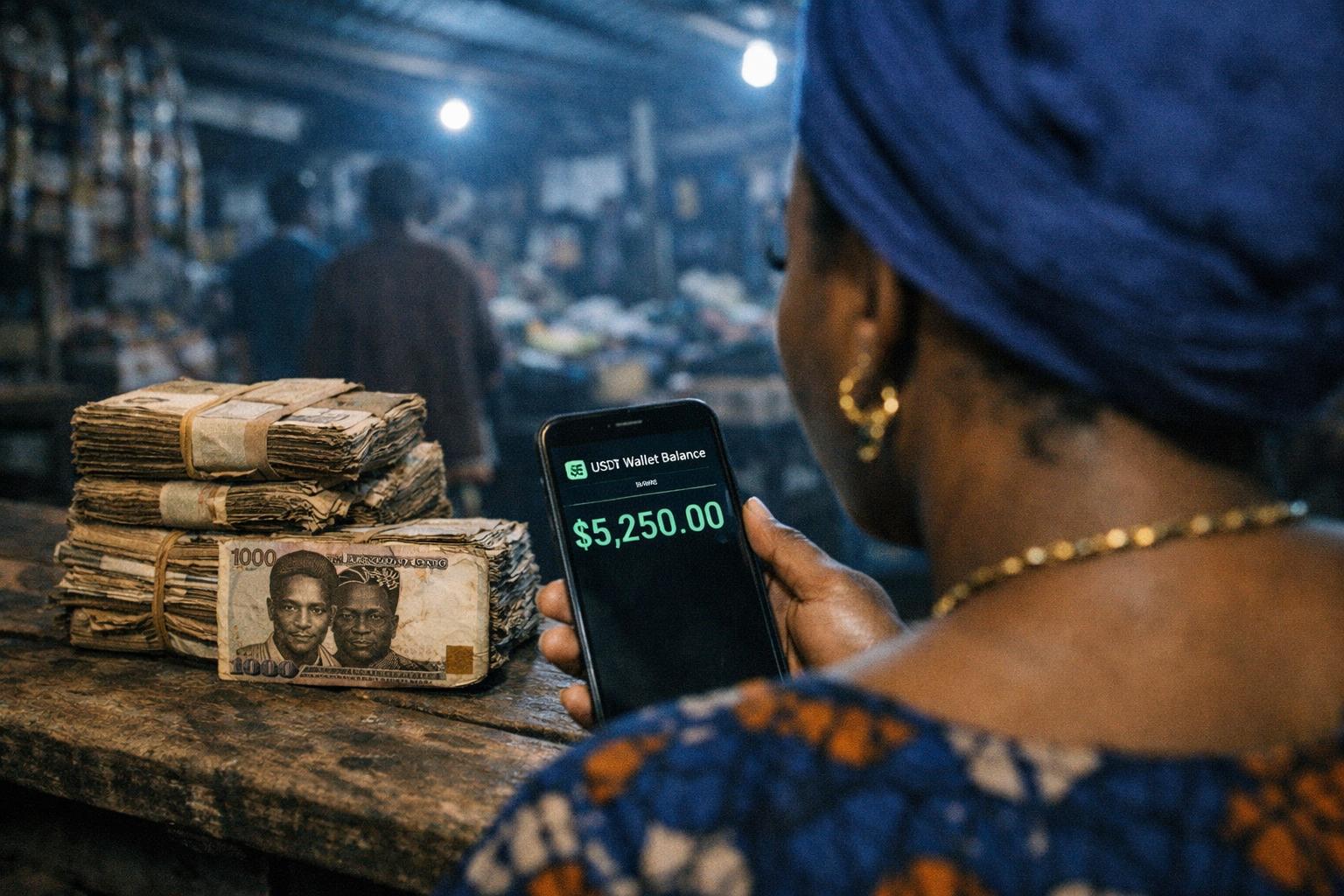
In June 2023, a Lagos fabric trader paid a Chinese textile supplier in USDT for the first time. She had used SWIFT bank transfers for five years. The day she switched, the naira had lost twelve percent of its value in seventy-two hours.
She was not buying stablecoins because she understood decentralised finance. She was buying them because her bank could not give her dollars.
The Central Bank of Nigeria abandoned its controlled exchange rate system in June 2023. Within one week, the official naira rate moved from NGN 464 to NGN 708 per dollar. By February 2024, the naira had fallen past NGN 1,400. The currency lost more than sixty percent of its value in eight months.
P2P trading volumes spiked immediately. Nigeria became Sub-Saharan Africa's largest P2P market by the end of 2023. Between July 2023 and June 2024, Nigeria received $59 billion in crypto-asset inflows. USDT on TRON accounted for 88.5 percent of stablecoin activity. Not Ethereum. Not DeFi protocols. Low transaction fees on TRON made it the practical default for traders moving money across borders.
Sub-Saharan Africa now has the world's highest stablecoin adoption rate at 9.3 percent. Nigeria alone accounts for 60 percent of the region's stablecoin inflows. The mobile money infrastructure that moves over a trillion dollars annually now shares the continent with a parallel dollar-denominated system. That parallel system has 25.9 million Nigerian users and is growing.
In June 2026, the IMF published a paper titled "Stablecoins in Nigeria: A Growing Cross-Border Channel." The paper called the phenomenon digital dollarization. Stablecoin inflows were reducing demand for the naira and weakening the CBN's ability to conduct monetary policy. The CBN had already attempted to restrict P2P trading in 2024. The volumes continued.
The IMF is not describing a speculative crypto market. It is describing currency substitution at scale. Users holding USDT in Nigeria are not earning yield or providing liquidity. They are preserving dollar value, paying overseas suppliers, and receiving cross-border payments. The product logic for builders is entirely different from the DeFi playbook.
The settlement rails already exist. TRON-based USDT is fast, cheap, and trusted by tens of millions of people across West and East Africa. The products being built on top are savings interfaces, supplier payment tools, and cross-border payroll systems. They address the same cross-border problem that conventional remittance channels solve at eight to ten percent in fees. The stablecoin route costs under one percent.
The regulatory framework governing these products is still catching up. Nigeria launched cNGN, a naira-backed stablecoin under CBN supervision, in 2025. The regulatory debate is about monetary sovereignty, not prohibition. That distinction determines which rails remain legally viable for builders over the next three years.
Africa's stablecoin adoption started as an emergency response to currency collapse. It is becoming the payment layer.