

A startup founder in Lagos building an AI customer support product ran the API cost calculation in month four. Not month one. Month four, after the product had 300 active users and real token volume.
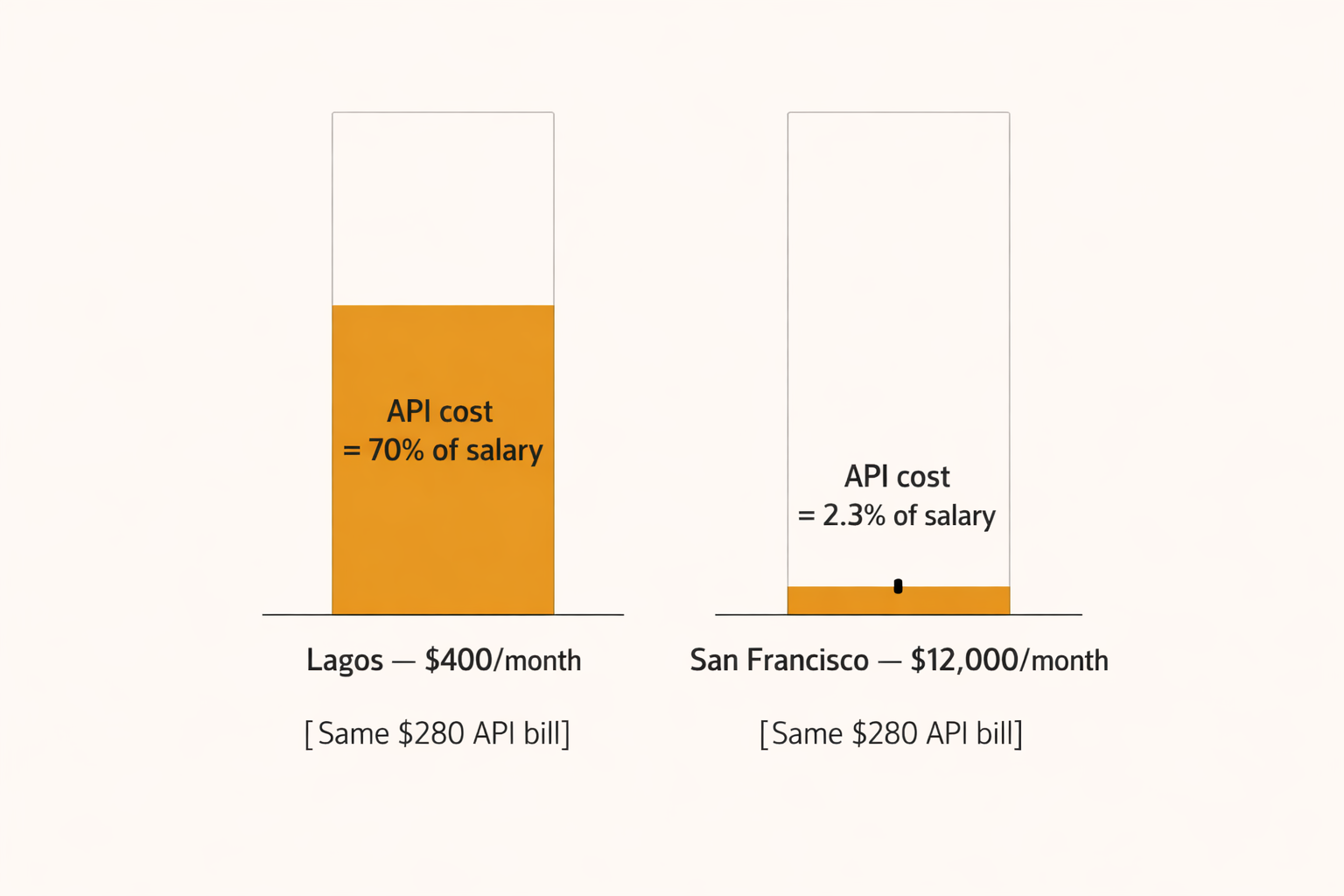
At 2,500 output tokens per user session, 300 daily active users generate 22.5 million output tokens per month. GPT-4o API pricing at $10 per million output tokens puts the monthly output cost at $225. Input tokens at $2.50 per million add another $56. Monthly API spend: $280, before infrastructure or margin.
In Lagos, a junior software developer earns approximately $400 to $600 per month. The API bill for that product is more than half of that salary - every month, before the first revenue lands.
For the same product at the same usage, a US team spends under 3 percent of a developer salary. Same product. Same API. Two different cost structures.
The API providers have not adjusted for this. There is no regional pricing for API access equivalent to what Google introduced for consumer subscriptions in African markets. The cost differential is structural.
The comparison explains the pattern. African AI founders building on open-weight models are not making a technical trade-off. Qwen3, DeepSeek R1, and Gemma 4, running locally through Ollama, replace recurring API costs with one-time hardware amortisation. For many African AI builders, this is not a workaround. It is the rational outcome of running that comparison.
Affording the model is a constraint for African AI startups in a way it is not for most US ones. The constraint does not produce inferior products. It produces products designed for different economics.
LLM cost in Africa is not a pricing complaint. It is an architecture decision.
The tools African founders choose show how that decision changes the application layer.